

CULTURE- She Learned Ski Craft on the Factory Floor & Becaome Part of the First Parent-Child Team to Summit Ama Dablam. Now She Designs the Art That Moves With the Mountian.

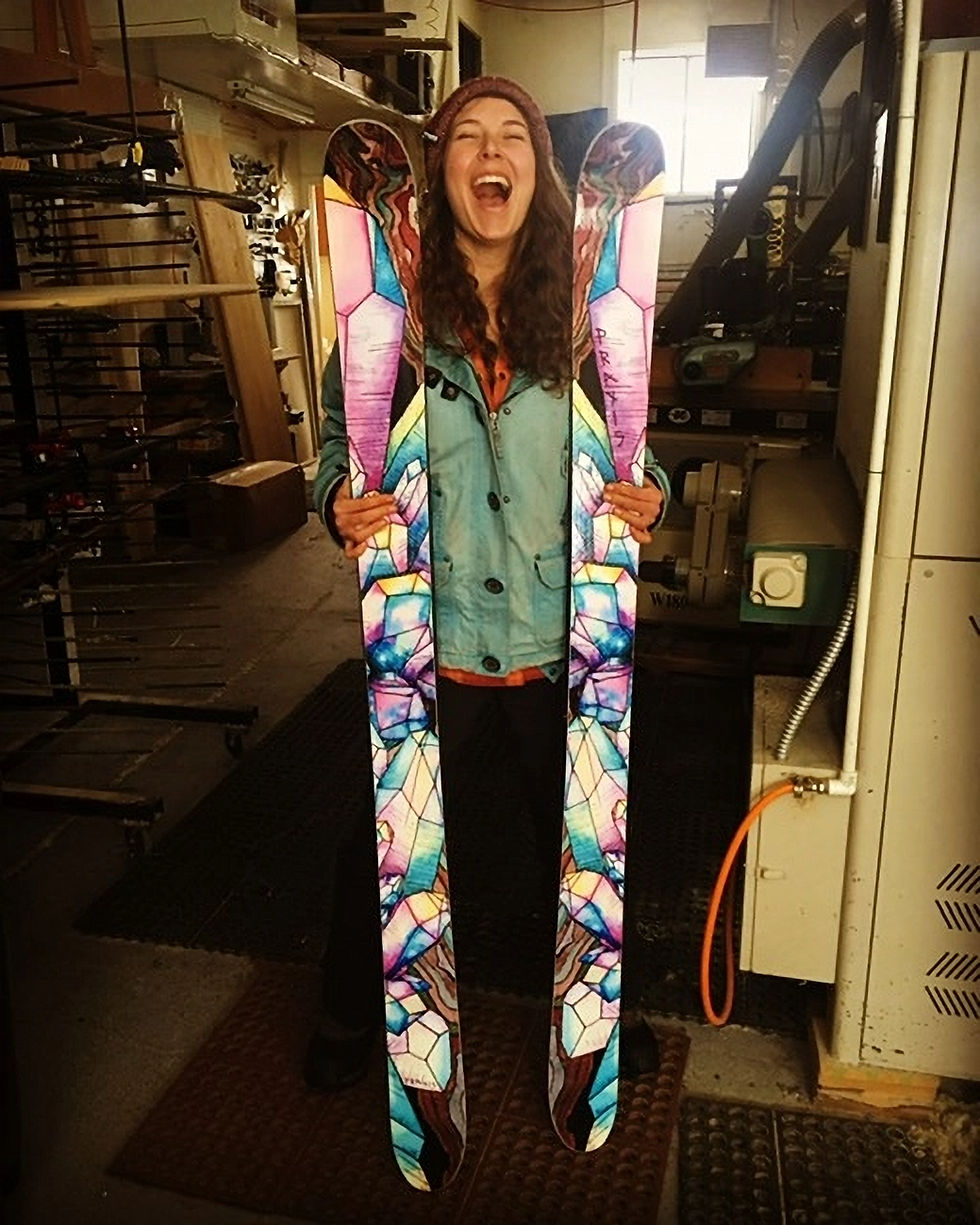
Kinetic Art Built to Breathe on Snow
The first thing you notice in a ski factory isn’t the noise. It’s the heat. The air hangs heavy with resin and sawdust, presses exhale in slow mechanical rhythms, and the whole place hums with the kind of focus that comes from knowing one wrong move can ruin a pair of skis—or a hand.
This was Sam’s classroom.
Women rarely end up on the factory floor, but at Praxis the rarity never became the story. They brought her into the craft the same way they do anyone serious about the work—quietly, directly, and without ceremony.
Before she ever designed a ski graphic, she learned how a ski is born: under pressure, heat, and the kind of precision that leaves no room for ego.

Where Craft Teaches You to See Differently
Most artists never witness the moment their work meets the machinery. Sam saw everything.
She watched colors shift under heat, lines distort under pressure, textures vanish when the press came down a fraction too hard. She learned how nylon stretches, how resin bleeds into detail, how a topsheet can betray you if you don’t respect the template.
It made her meticulous. It made her patient. It made her understand that art isn’t finished until it survives the press.
And it gave her something rare: a sense of how graphics move—how they flex, catch light, and come alive only when someone points them downhill.

The Mountain’s Two Lessons
Sam doesn’t talk about the mountains as a single story. For her, they’re a study in duality—darkness and light, fear and resolve, the moments that take and the moments that give. Two experiences shaped that understanding: surviving an avalanche in the backcountry, and later standing on the summit of Ama Dablam as part of the first parent–child team to reach it.
The avalanche was the dark half of the lesson. One moment she was moving through familiar terrain; the next she was fighting for breath, for direction, for any chance to stay above the debris. Fear sharpened into resolve because it had to.
Ama Dablam was the light. High Camp at 20,500 feet, sick, depleted, unsure she had anything left—the fear was different but familiar. And again, it shifted. One step. Then another. The same resolve, but this time toward something instead of away from it.
Those two moments—one born in shadow, one in sunrise—shaped the way she sees the mountains, and the way she makes art about them.

A Father Who Taught Her to See the World in Color
Sam’s father didn’t teach her technique. He taught her perception.
He saw beauty in everything—the grand, the strange, the overlooked, the things most people dismiss as “ugly.” He lived with a kind of shameless authenticity, expressing himself without hesitation or filter.
It’s the perspective that still shapes everything she makes.
Her most personal pieces feel like secrets whispered by the natural world.

Translating Mountain Energy Into Story
Sam’s graphics carry a distinct voice because they’re rooted in lived experience. She pulls from metamorphic rock that looks like frozen movement, from fungi that seem too strange to be real, from skies that feel like portals.
Her art isn’t literal. It’s atmospheric. It’s emotional. It’s the memory of a place, not the picture of it.
She studies other artists obsessively—not to imitate, but to understand how they create feeling. Then she twists it into something unmistakably hers.
What Ski Art Could Become
Sam doesn’t think ski art is missing anything. She thinks it’s under‑explored.
Too many graphics lean on the same aesthetic: aggressive, minimal, “badass.” She wants deeper narratives—place‑based stories, cultural threads, themes that honor the regions and communities that shaped skiing long before it became an industry.
She wants graphics that speak to more than one demographic. Power can be quiet. Subtlety can be bold. Not every skier wants to project rebellion. Some want to project soul.
Praxis, she notes, is one of the few brands already pushing this—working with local artists, embracing regional identity, and giving each model its own visual language. They’re proof that craft and story can coexist.

The Dream Graphic
If she could design anything, she’d start with rock—textures that look solid but feel fluid, like magma caught mid‑flow. She’d overlay iridescent or color‑shifting elements to make the ski feel alive, dreamlike, almost breathing.
Not psychedelic for shock value—psychedelic in the sense of wonder. The kind of visual that makes you question whether you’re imagining it.
What She Hopes Riders Feel
She wants the art to meet riders in motion—to give them a feeling that stays.
Because for Sam, the art isn’t the final product. The final product is the moment someone drops in, and the mountain brings the art to life.


Comments